News Centre HomePress ReleaseOver a third (37%) of Brits are more likely to open a scam message at Christmas as festive noise helps fraudsters blend in
New research from Vodafone reveals over a third of Brits (37%) are more likely to accidentally open a scam message at Christmas, as the festive rush brings an increase in emails and messages, changes in shopping habits, busier social lives, and extra deliveries.
An increase in festive distractions make scam messages harder to spot for 38% of Brits, while one in five (19%) no longer trust their ability to tell what’s real from what’s not.
Higher volumes of deal alerts (42%), messages from loved ones (35%), and payment alerts (22%) add to the festive noise, making sophisticated scams more difficult to spot.
The search for the right gift adds to the mix, with 27% more likely to buy from an unfamiliar website if a hard-to-find item is available.
With deliveries up an average of 50% over the festive period, over a quarter of people (26%) struggle to keep track of which couriers are delivering their parcels, making legitimate updates harder to trust.
This Fraud Awareness Week, Vodafone launches its 12 Scams of Christmas campaign, highlighting the scams to watch out for over the festive season, and encouraging people to help tackle fraud by reporting suspicious messages and calls to 7726.
As well as supporting customers with advice and guidance, VodafoneThree has blocked more than 112.3 million fraudulent SMS messages in the last 12 months, while it blocks 1.7 million fraudulent calls every day.
From deals alerts (42%) and parcel updates (34%) to messages from loved ones (35%) and payment alerts (22%), Brits are receiving a flurry of festive notifications. This ‘scam-oflage’ effect gives fraudulent messages more opportunity to hide among real communications, making them more difficult to identify.
At the same time, increasingly sophisticated scams are making it harder for people to know what to trust. Over a third (38%) say they struggle to distinguish real messages from scams at this time of year, while one in five (19%) no longer trust their ability to tell what’s real from what’s not.
This is making Brits suspicious of legitimate messages, with almost a third (31%) admitting they have deleted a message they later discovered was genuine, and 34% now saying the majority of festive notifications they receive feel like spam.
How to avoid scams during the holiday shopping season
As Black Friday heralds the start of Christmas shopping season, both individuals and businesses should heed the following advice to make sure they stay safe and scam-free over the holidays.
The research comes as Vodafone launches its 12 Scams of Christmas campaign to mark Fraud Awareness Week and help people navigate the evolving fraud landscape. The campaign highlights the scams to watch out for this festive season, with top tips to spot fraudulent activity and guidance on how people can help tackle fraud and scams by reporting suspicious messages or calls to 7726, free of charge.
VodafoneThree’s own data shows spam report volumes reached their festive peak on 1 December last year, just after Black Friday, as fraudsters attempted to take advantage of one of the nation’s busiest times of the year. Some of the scams most reported over Christmas were false competitions and prizes, ‘Hi Mum’ messages, and finance scams or fraudulent investment offers.
Caught in a festive flurry
The research, commissioned by Vodafone to explore the experiences of 2,000 Brits, also identified how changes in routine over the festive period can make people more vulnerable to scams and create new opportunities for fraudsters.
With many Brits enjoying packed festive schedules, 17% say they are quicker to act on unexpected messages than at other times of year. Meanwhile, 31% say they respond to messages when multitasking, with one in five (21%) admitting they overlook fraud warning signs as a result.
say they are quicker to act on unexpected messages than at other times of year.
17%
say they respond to messages when multitasking
31%
admit they overlook fraud warning signs as a result
21%
Making a list, checking it twice
Finding the right present can add another layer of pressure, particularly when gifts are harder to track down. More than one in five people (22%) say they alter their usual shopping approach in search of the perfect gift, while over a quarter (27%) are more likely to buy from an unfamiliar website if a hard-to-find item appears to be available.
Tighter budgets and last-minute shopping also play a part, with low prices (32%) and the promise of delivery before Christmas (24%) among the reasons people try somewhere new, adding messages from a wider range of retailers into an already busy mix.
And with all the Christmas shopping, Brits are finding themselves bombarded with delivery messages, receiving an average of three parcels a week – 50% more than usual – while one in five (21%) receive five or more.
With more deliveries to juggle, a quarter (26%) of Brits say they struggle to keep track of which couriers are delivering their parcels, making it harder to distinguish genuine delivery updates from potential scams.
Commenting on the findings, Psychologist, Dr Linda Papadopoulos, said: “Scammers are particularly effective at exploiting two powerful psychological triggers, urgency and emotion and at Christmas, it’s easy to feel pressured into acting quickly. A message about a missed delivery or a limited-time offer can tap into those anxieties, encouraging us to react before we’ve had time to think.
“If a message makes you feel anxious, excited or pressured to act immediately, that’s precisely when you should slow down. It’s not about being suspicious of everything, but about developing small habits that help us make better decisions, particularly when life gets busy.”
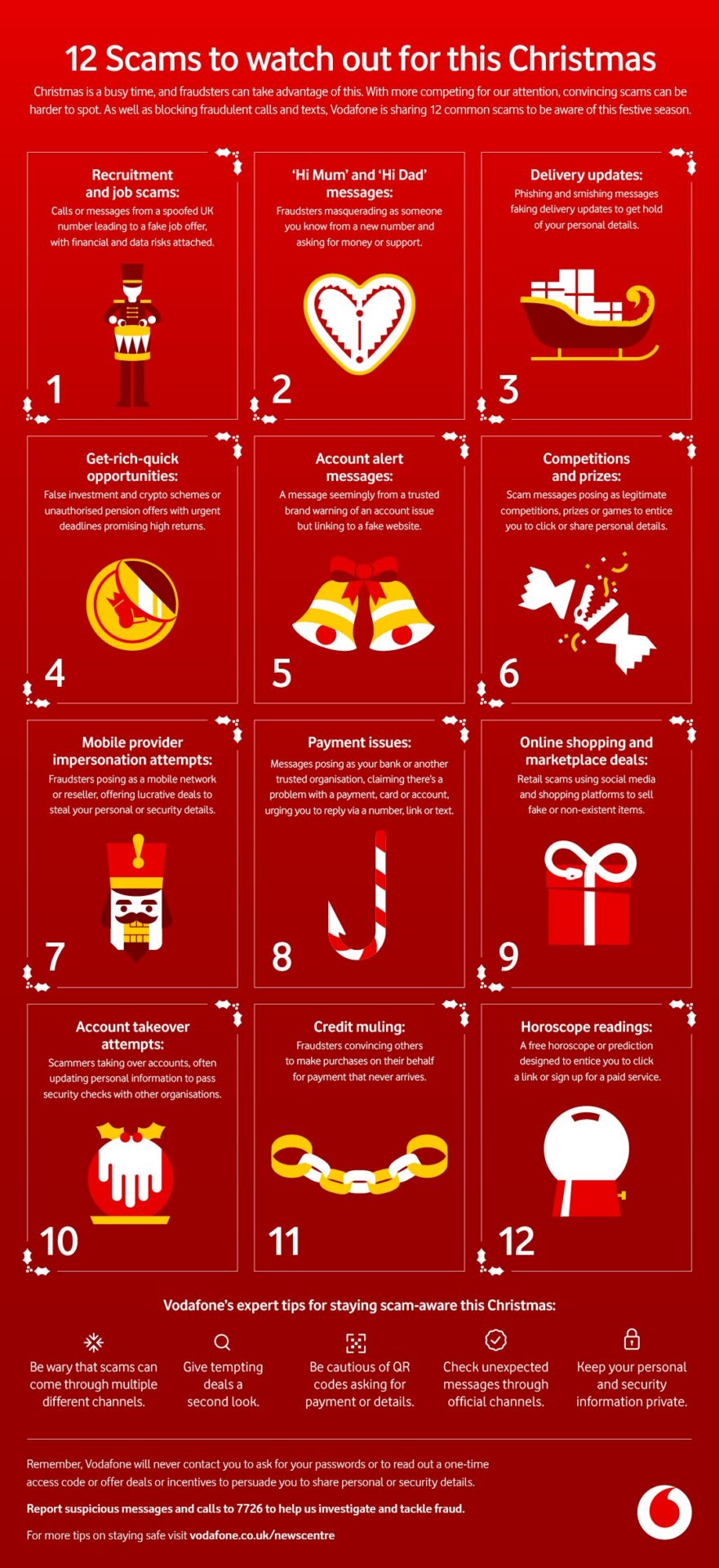
12 scams to watch out for this Christmas, based on the VodafoneThree anti-fraud team's analysis of 2025 data and current trends.
The cost of Christmas scams
The study revealed that, for more than 5.5 million* Brits, the festive flurry has seen them fall victim to a scam over the Christmas period. Financial loss was reported by 44% of those targeted, but the impact extends beyond, with 38% reporting an impact on their mental health and 23% on their physical health as a result.
Despite this, many suspicious messages and calls still go unreported. Only 31% of Brits say they reported the last scam message they received, with 21% deleting it and 18% ignoring it completely. While avoiding engagement is an important step, reporting suspicious activity can help prevent the same scams from reaching others.
Rachel Andrews, Corporate Security and Fraud Director, VodafoneThree, said: “Christmas is a busy time, which can make it easier for fraudulent messages and calls to blend in. At VodafoneThree, we’re tackling fraud on multiple fronts, helping customers recognise the scams they’re most likely to see, using network intelligence and AI to block fraudulent activity before it reaches them, and working across industry to disrupt the criminal networks behind it.
“We’d encourage everyone to check unexpected calls and messages, particularly during the festive season, and report anything suspicious to 7726, so we can investigate and take action against fraudsters.”
Customers on any UK mobile network can report suspicious messages and calls to 7726, the UK’s free number for reporting spam texts and calls. Messages can be forwarded directly to 7726, while calls can be reported by texting ‘CALL’ to 7726, followed by the suspected phone number.
Android users can also use ‘Report Spam’, while iPhone users can select ‘Report Junk’. VodafoneThree’s anti-fraud team regularly reviews these reports to identify and block scam messages, sender IDs, and any links to prevent them reaching others.
say they struggle to keep track of which couriers are delivering their parcels
26%
say they reported the last scam message they received
31%
have reported financial loss as a result of a scam
44%
Alex Wood, Counter Fraud Expert, Broadcaster & Writer, added: “Fraudsters rely on silence as much as deception. Many people feel embarrassed after being scammed and convince themselves there’s no point reporting it. But every report helps build a clearer picture of how these criminals operate.
“What might seem like a single scam message or phone call could be the missing piece that helps investigators connect the dots, disrupt wider fraud networks and prevent others from falling victim to increasingly sophisticated scams.”
As well as supporting customers with advice and guidance on avoiding and reporting scams, VodafoneThree has blocked more than 112.3 million fraudulent SMS messages in the last 12 months and blocks 1.7 million fraudulent calls every day.
Its anti-fraud team monitors trends and quickly responds to new threats, and its investment in AI technology helps identify behavioural patterns that could indicate fraudulent activity across its network. Meanwhile, Vodafone Secure Net’s Scam Call Protection analyses incoming calls in real time and has flagged more than 13 million fraudulent calls since its launch earlier this year.
Anyone concerned they may have been a victim of fraud can find further information and support on the Vodafone or Three webistes.
The 12 Scams to watch out for this Christmas,based on the VodafoneThree anti-fraud team’s analysis of 2025 Christmas data and current trends:
Recruitment and job offers: Calls or messages from a spoofed UK number leading to a fake job offer, with financial and data risks attached
‘Hi Mum’ and ‘Hi Dad’ messages: Fraudsters masquerading as someone you know from a new number and asking for money or support
Delivery updates: Phishing and smishing messages faking delivery updates to get hold of your personal details
Get-rich-quick opportunities: False investment and crypto schemes or unauthorised pension offers with urgent deadlines promising high returns
Account alert messages: A message seemingly from a trusted brand warning of an account issue but linking to a fake website
Competitions and prizes: Scam messages posing as legitimate competitions, prizes or games to entice you to click or share personal details
Mobile provider impersonation attempts: Fraudsters impersonating a mobile network or reseller and offering lucrative deals to steal personal or security information
Payment issues: Fraudulent messages posing as your bank or another trusted organisation, claiming there’s a problem with your payment, card or account, urging you to reply via a specific number, link or text
Online shopping and marketplace deals: Retail scams using social media and shopping platforms to sell fake or non-existent items
Account takeover attempts: Scammers taking over accounts, often updating personal information to pass security checks with other organisations
Credit muling: Fraudsters convincing others to make purchases on their behalf in return for financial compensation that is never provided
Horoscope readings: A free horoscope or prediction designed to entice you to click a link or sign up for a paid service
VodafoneThree’s expert tips for staying scam-aware this Christmas:
Check unexpected messages through official channels: Whether it’s a delivery update, bank alert, account warning or request from someone you know, verify it independently using the organisation’s official website, app or phone number rather than clicking a link or using contact details in the message.
Give tempting deals a second look: Research unfamiliar retailers, check independent reviews and be wary of unusually low prices, limited time offers or investment opportunities that seem too good to be true.
Keep personal and security information private: Never share a one-time code unless you’re sure you’re speaking with, or have contacted, a legitimate business.
Be wary that scams can come through multiple different channels: Unexpected or fraudulent contact can come through texts, messaging apps, social media or phone calls, so take a moment to check anything that doesn’t seem right, particularly where there is pressure to act quickly.
Report suspicious messages and calls: Forward suspicious messages and calls to 7726, the UK’s free number for reporting spam texts and scam calls, or use ‘Report Spam’ on Android and ‘Report Junk’ on iPhone.
Be cautious of QR codes: Scammers can use QR codes to take you to fake websites designed to steal your personal, payment or security details. If a QR code asks you to log in or make a payment, go directly to the organisation’s official website or app instead.
Remember, Vodafone will never contact you to ask for your passwords or to read out a one-time access code, or offer deals or incentives to persuade you to share personal or security details.
Fraudsters will ask you for these details, but Vodafone never will
Scammers will try to trick you into buying expensive phones for their benefit. Here’s how to stay safe and keep ahead of the fraudsters.
The research was conducted by Censuswide, among a sample of 2002 Consumers (Nat Rep 18+). The data was collected between 06.11.2026 – 10.11.2026. Censuswide is a member of the Market Research Society (MRS) and the British Polling Council (BPC), and a signatory of the Global Data Quality Pledge. We adhere to the MRS Code of Conduct and ESOMAR principles.
VodafoneThree internal Fraud data was collected and assessed between November 2025 and October 2026.
About VodafoneThree
VodafoneThree is the UK’s largest mobile network operator serving the fixed and mobile market, formed following the merger of Vodafone UK and Three UK in June 2025.
Through an unprecedented £11 billion investment, VodafoneThree will build the UK’s best network. The network will deliver reliable, quality connectivity to all nations and regions, creating as many as 13,000 jobs and laying a digital foundation for the country’s growth ambitions.
VodafoneThree is the only mobile network operator with a fully funded, regulated and guaranteed network build plan, reaching 99% 5G Standalone population coverage by 2030 and 99.96% by 2034. From big cities to small towns, and everywhere in between, the company’s mission is to build the UK’s best network.
VodafoneThree encompasses all businesses and assets, including Vodafone UK, Three UK, VOXI Mobile, SMARTY and Talkmobile.
Vodafone UK is a technology communications company that connects people, businesses and devices to help our customers benefit from digital innovation. Our services span mobile, fixed-line connections, home and office broadband, and the Internet of Things (IoT).
We have a strong track record as a tech pioneer, making the UK’s first mobile phone call, sending the first text message, and making the UK’s first live holographic call using 5G in 2018. We were the first to start carrying live 5G traffic from a site in Salford, Greater Manchester and now have 5G in locations across Germany, Ireland, Italy, Spain as well as the UK. Meanwhile, our 4G network coverage currently reaches over 99% of the UK population.
Today, Vodafone serves more than 20 million unique full fibre premises in the UK through partnerships with CityFibre and Openreach.
For more information about Vodafone UK, please visit: www.vodafone.co.uk